Water Filters That Reduce Fluoride: An Honest UK Comparison
I filter my water at home mostly for taste, and because I like knowing what's coming out of my tap. Fluoride's part of that for me. That's my choice and not a recommendation. Below is what I use, then an honest comparison of the main filter types that actually reduce fluoride, and the ones that don't. Where the evidence is thin, I'll tell you.
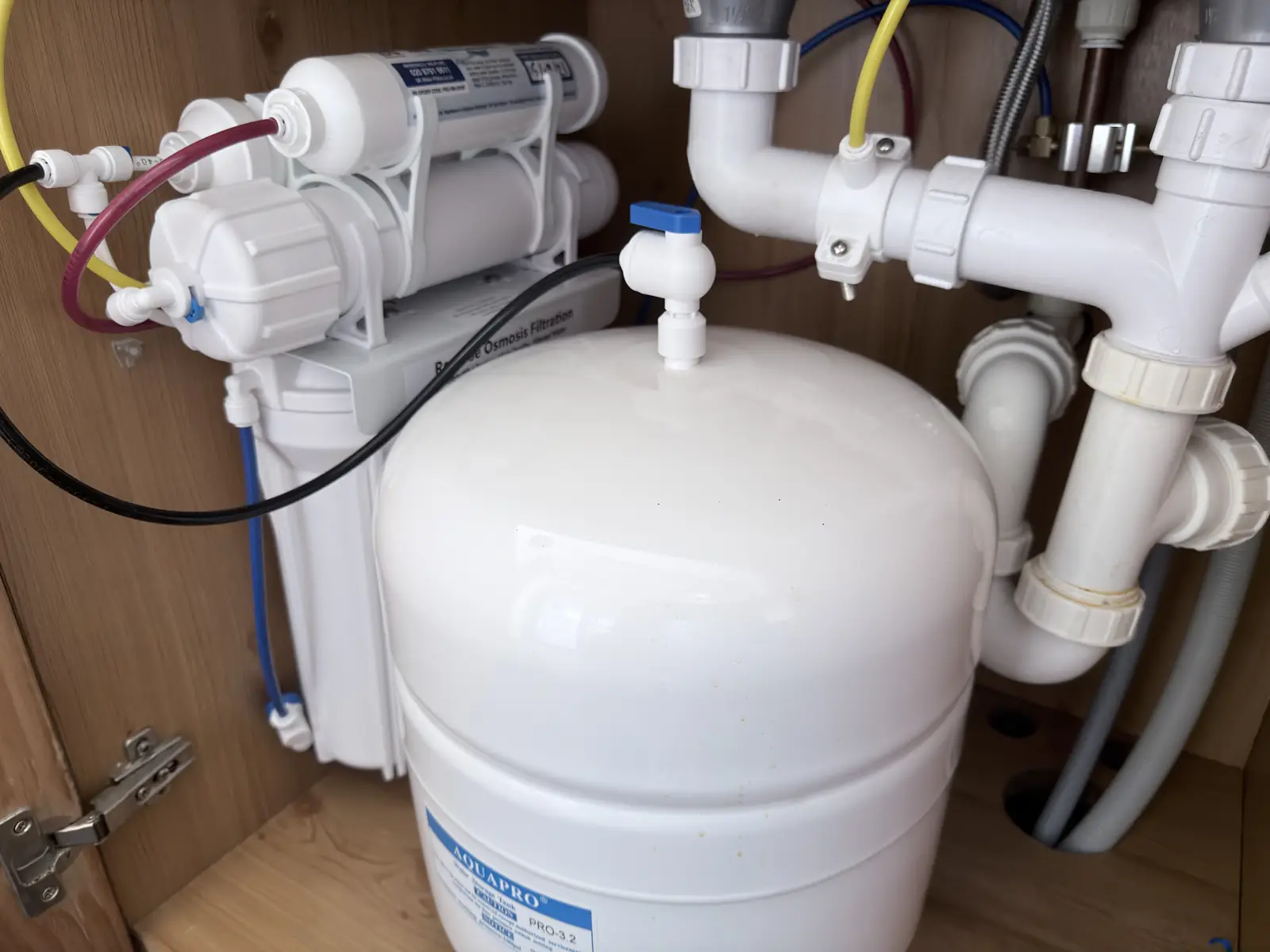
I've had it for about two to three years now. I fitted it myself. It's an easy DIY job and took me about 30 minutes, start to finish. Why this one? Honestly, I think it's probably the best filter system out there and good value for money, but that's just my opinion.
The one thing I'd moan about is the replacement membrane. The maker's own one is pricey, so shop around. I found one for around £18.99 (as checked by me, not the maker's price), and in my house it needs changing roughly every 18 months. The other filters cost me about £39 and I change them every 6 months. That's my own experience, so your water and usage might differ.
A few facts from the maker's page (as checked 18 October 2026), so you know what you're looking at:
What they claim it removes: fluoride is on their list, along with chlorine, lead, microplastics and more. They quote a "98%+" rejection rate for dissolved solids. That's the maker's claim, though. I haven't seen an independent fluoride test for this exact unit, so I'm not putting a fluoride percentage on it.
Price: £287 (as checked 18 Oct 2026).
Upkeep: a pack of five filters every 6 months at £39.95 (as checked 18 Oct 2026), and the membrane every 2–3 years depending on your water at £79 (as checked 18 Oct 2026). They put running costs at about 31p a day (as checked 18 Oct 2026).
Waste water: they say about 70% of the water going in is rejected and sent down the drain. That only applies to the water you run through the RO tap, not your whole house. By my maths it's still roughly 2 to 2.5 litres down the drain for every litre you drink. Some people catch it for the garden.
Minerals: RO strips minerals out, so this system adds some back with a remineralising cartridge.
I got it mainly for the chlorine. In a hot shower you're standing in the steam, and I'd rather not be breathing in chlorine vapour while I'm at it. Chlorine's also harsh on your hair, so this is a handy one if you've got long hair or colour it. That's just why I like it. It's my experience, not a promise.
What it's for, going by the maker's page (as checked 18 October 2026): they say it reduces up to 99% of chlorine, and that it reduces some other contaminants and scale. They also say exact figures for anything other than chlorine will vary with your flow, temperature and water. It screws onto a standard UK shower hose in a couple of minutes, you swap it every 6 months, and it was £39.95 (as checked 18 Oct 2026) in their October sale. The usual price is £49.95 (as checked 18 Oct 2026).
To be clear: a shower filter isn't a fluoride filter. This one doesn't claim to remove fluoride, and shower filters generally aren't built for it. NSF's own guide says shower filters certified under NSF/ANSI 177 are certified to reduce free chlorine only. If fluoride's your reason for filtering, the shower head isn't the bit doing that job.
The main ways to reduce fluoride, compared
Quick version: reverse osmosis and distillation are the two that the bigger bodies consistently say remove most fluoride when working properly. Activated alumina and bone char can work, but results depend heavily on the product and your water. Standard carbon jugs aren't designed for it.
How the main fluoride filter types compare
Type
How it works
What the evidence says about fluoride
Rough UK cost (as checked 18 Oct 2026)
Upkeep
Waste / energy
Reverse osmosis (under-sink)
Mains pressure pushes water through a very fine membrane. Most dissolved stuff stays behind and is flushed away.
Fluoride reduction is an optional claim under NSF/ANSI 58. The CDC says RO "may" reduce fluoride, so check the label. The ADA says working RO systems remove most fluoride.
£287 (as checked 18 Oct 2026), UK Water Filters
Pre/post filters every 6 months, membrane every 2–3 years (that system: £39.95 (as checked 18 Oct 2026) and £79 (as checked 18 Oct 2026))
No electricity on the standard model, but about 70% of incoming water goes down the drain (maker's figure)
Activated alumina
Water runs slowly through aluminium oxide granules, and fluoride sticks to them.
Can remove a lot, but WHO says capacity is "highly dependent on pH" (best around pH 5), varies by brand, and field results are often far lower than lab figures. WHO also noted there were no international performance standards for home units.
e.g. £175.99 (as checked 18 Oct 2026) for a UK-made mains kit (Fountain Filters Moby F). The maker claims 10ppm down to under 0.2ppm in lab conditions.
Cartridge life depends on your fluoride level and how much you use. No fixed interval.
No waste water and no power. Runs at a slow flow because it needs contact time.
Bone char
Charred animal bone. Fluoride swaps onto the calcium phosphate in the char.
Can remove a significant amount (ADA), but WHO is blunt that quality depends on how it's made: poorly made char removes less and can make water taste and smell bad. Results vary by brand.
e.g. £21.60 (as checked 18 Oct 2026) for a 10" drop-in cartridge (Direct Water Filters). Needs a filter housing.
Retailer quotes 6–12 months, depending on your water.
No waste water and no power. Made from cattle bone, worth knowing if you're veggie or vegan.
Countertop distiller
Boils the water and collects the steam as it condenses. Minerals and most contaminants stay in the boiling chamber.
The ADA says working distillers remove most fluoride. A small 1991 study measured 99% for the distiller it tested. NSF/ANSI 62 is the standard for distillers.
e.g. £119.97 (as checked 18 Oct 2026) for a 4L steel distiller from Water Pure, special price; regular £229.97 (as checked 18 Oct 2026)
Carbon post-filter every 6–12 weeks, plus regular descaling of the chamber
No waste water, but plenty of power. That one is 750W for about 3.5 hours per 4 litres, roughly 2.6 kWh per batch by my maths. Slow, and not one for the van battery.
Standard filter jug (carbon / ion exchange)
Carbon and resin cartridge. Aimed at taste, chlorine, limescale, lead and copper.
Brita UK says plainly that its filters "are not designed to remove fluoride". The ADA says most carbon filters don't remove fluoride. One old study did find a carbon unit cut fluoride a lot, so check the data for that exact filter rather than assuming either way. More in Do water filter jugs remove fluoride? (UK).
Not checked
Brita: new cartridge every 4 weeks / 150 litres
No waste water and no power
What I'd look for whichever type you pick: a named standard (NSF/ANSI 58 for RO, NSF/ANSI 62 for distillers), a fluoride claim that covers that exact model, and a test report you can actually open. A big number on the box isn't enough.
Where the evidence is weak (being straight with you)
Bone char varies a lot by brand and by how it was made. WHO's guidance says badly made char loses capacity and can taint the taste. Most of the "it removes X%" figures you'll see online are from sellers.
Activated alumina works best in slightly acidic water and needs slow contact time. In a normal home you can't easily tune your water's pH. WHO notes real-world capacity is often far below lab figures, and that home units lacked international performance standards.
Jugs: mainstream carbon jugs aren't built for fluoride. There are specialist "fluoride jugs" with alumina inside, but I haven't checked any independent data on them.
My own RO: the fluoride claim is the maker's. I haven't seen an independent fluoride test for my exact unit.
Cartridge age matters for all of them. A filter that's past its life won't perform like a fresh one.
How to read a filter test report
Brands love a big number. Here's what I check before I believe one:
Who tested it? Look for an independent lab or certification body, not the brand's own marketing. Note the lab's name and the report date.
Which standard? Certification is against a named standard. For example, NSF/ANSI 58 (for point-of-use reverse-osmosis systems) includes fluoride reduction as an optional claim. Check that the listing actually covers fluoride, not just other contaminants.
This exact model? Certification covers specific models and cartridges, not a whole brand. Match the model number.
What reduction, under what conditions? Find the published reduction percentage and the test conditions: starting concentration, flow rate, how many litres through the filter, and the water used.
How old is the filter? Performance can change across a cartridge's life. See whether the report tests to the end of the rated life.
Can you see the document? If there's no report you can open, I treat the claim as unverified.
We only treat an independent test report as proof. Where we mention a maker's claim or a study figure, we say so right next to it.
UK tap water and fluoride: check your own area first
UK tap water is properly regulated. In England and Wales the Drinking Water Inspectorate (DWI) checks that water companies stick to the rules, and the legal maximum for fluoride is 1.5 mg per litre. Where water is fluoridated, it's topped up to 1 mg per litre. Scotland has the DWQR, and Northern Ireland has DWI NI.
Only some areas are fluoridated. UK government guidance puts it at about 1 in 10 people in England, with no schemes in Scotland, Wales or Northern Ireland. Some areas have naturally occurring fluoride too. Close to home: Newcastle and Gateshead have had fluoridated water since the early 1970s, and in March 2025 the government decided to expand fluoridation across more of the North East.
Use your water company's postcode water-quality lookup (most have one), or ask them. The DWI says you can get a free copy of the test results for your supply.
Look for the fluoride line, shown in mg/l against the 1.5 mg/l limit.
If you've got questions about fluoride and your teeth or health, that's one for your dentist or GP and the UK government's oral health guidance, not a bloke with a filter under his sink.
Prices and specs as checked 18 October 2026. Prices change, so check the retailer before you buy.
Also at home
Dust Arrest Medi 8 UV-C HEPA air purifier
The air purifier I run at home.
Since I started using it I feel I can breathe better at home. It's great for clearing cooking smells, too. The air-quality light goes into the red whenever I spray an air freshener, which has put me off them.
Why I switched
Why I switched: I had a Vax Pure Air 300 before, which had no activated carbon filter, and then a Philips AC2936/33, which broke down just after a year, out of warranty. The Medi 8 has activated carbon, a HEPA 13 filter and UV-C, and it's the best one I've had.